

J.Boerman 9
“De installalatie keurig volgens offerte en tijdsplanning snel en vakkundig aangebracht.”
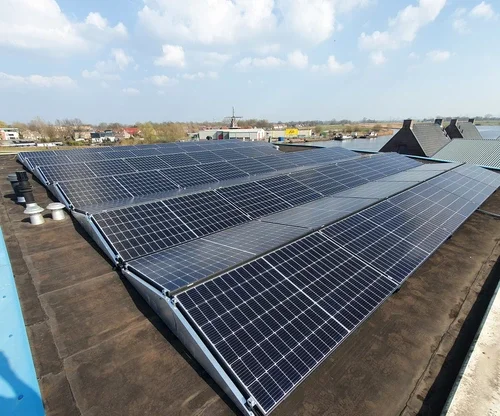
I have a flat roof. Are solar panels possible, and do they give a decent yield? Certainly. On a sloping roof you depend on the pitch and the orientation. On a flat roof you have freedom: you can face the panels south and set them at the right angle, which gives the best possible yield.
In this blog our adviser Mark tells you everything about fitting panels on a flat roof. What is the best angle, how are the panels mounted and how much ballast do they need?
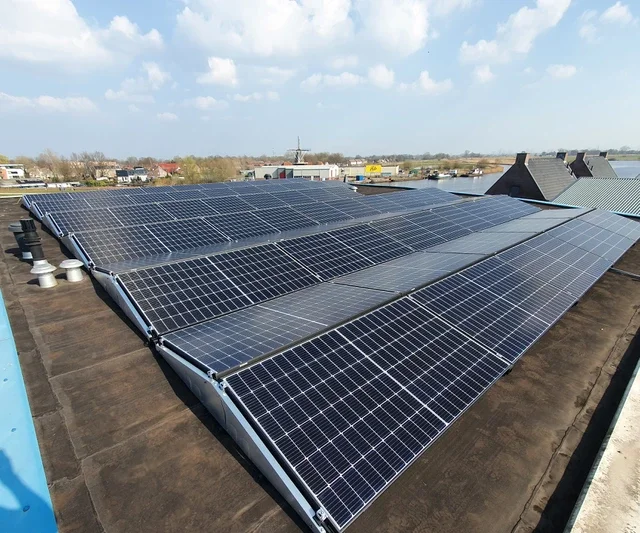
Precisely because the roof is flat, you have more freedom to place the panels in the best possible way for a high yield. They are laid out in rows at the best angle, and you can face them in more than one direction. On a sloping roof you depend on the pitch and the orientation, and the ideal placing is not always possible.
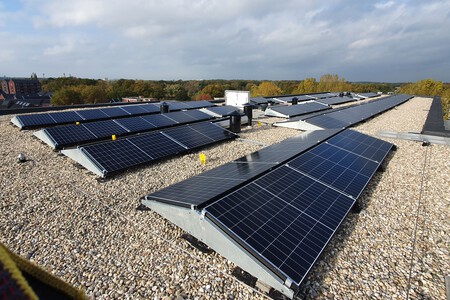
On a flat roof the panels are generally placed in rows one behind another. The distance between the rows follows from the angle of the panels, and it has to be right, because otherwise one row shades the next, which costs yield.
The surroundings affect the panels too. When a tree or another object casts shade on a panel, the yield suffers. Want to know more about how panels work? Then read the blog my colleague Hans wrote: "How do solar panels work?".
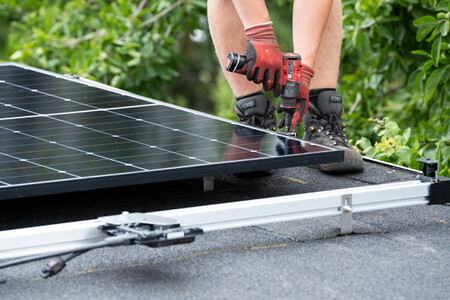
You can lay the panels landscape or portrait on a flat roof. Which you choose makes no difference to the yield, although panels in portrait need more ballast, are more visible and get dirty faster. As a rule panels are laid landscape.
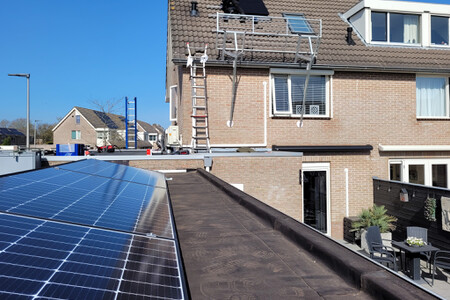
When it blows hard, the edge of a flat roof catches the most wind. So it matters that the panels are not laid right up to the edge: a safety margin keeps them out of the strongest wind. The closer the panels stand to the edge, the more ballast they need to stay put.
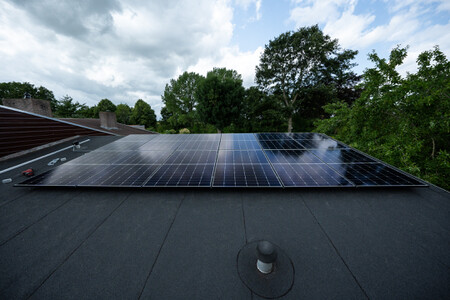
The weight of a solar panel system depends on how many panels it has. On a flat roof the panels sit in a console, which holds them at the right angle and is filled with ballast to keep them steady. The more panels you use, the larger and heavier the system is, which means less ballast is needed to hold it down.
A concrete roof usually needs no strengthening. If the flat roof is built of wood or steel, the structure may have to be adapted.
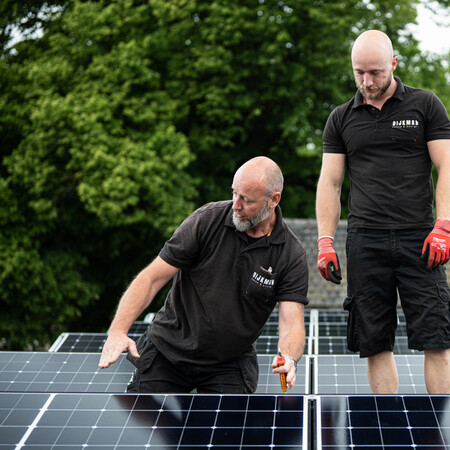
The cost of solar panels on a flat roof is no different from a sloping one. There is an extra cost for the consoles the panels sit in and for the ballast that holds the system down. Those consoles are what give the panels their angle. Read more about the cost of solar panels in the blog "The cost and yield of solar panels".
Curious what solar panels on a flat roof produce? Discover Max Control. Through a handy app it gives you a detailed view of what your panels and your other sustainable equipment generate.
Read more about Max Control

“De installalatie keurig volgens offerte en tijdsplanning snel en vakkundig aangebracht.”
Mark is a sales adviser at Dijkman Zonne-energie and is happy to answer all your questions about solar panels. A consultation can be online, by phone or at your home.
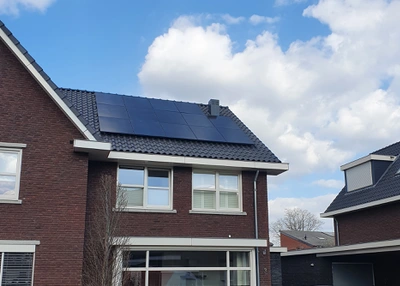
What is net metering? Why is the scheme being phased out and what will replace it?
Read more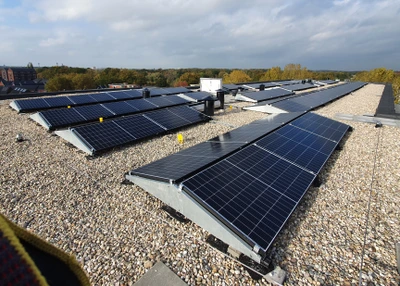
I have a flat roof, can I have solar panels too? Certainly. A flat roof even has a few advantages.
Read more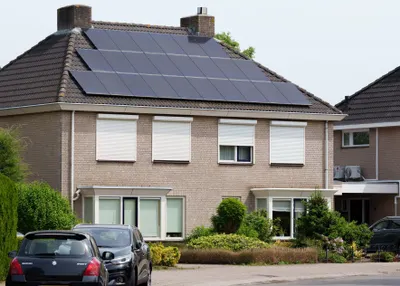
How do solar panels work? Our adviser Hans explains where solar energy comes from, what the inverter does and where panels work best.
Read more